
Worktop Joints Explained: Butt Joints, Mitres and Seamless Solid Surface
Most kitchens need at least one worktop joint. Learn how butt joints, mitred joints and seamless solid surface joints work, where they go and what a good joint…
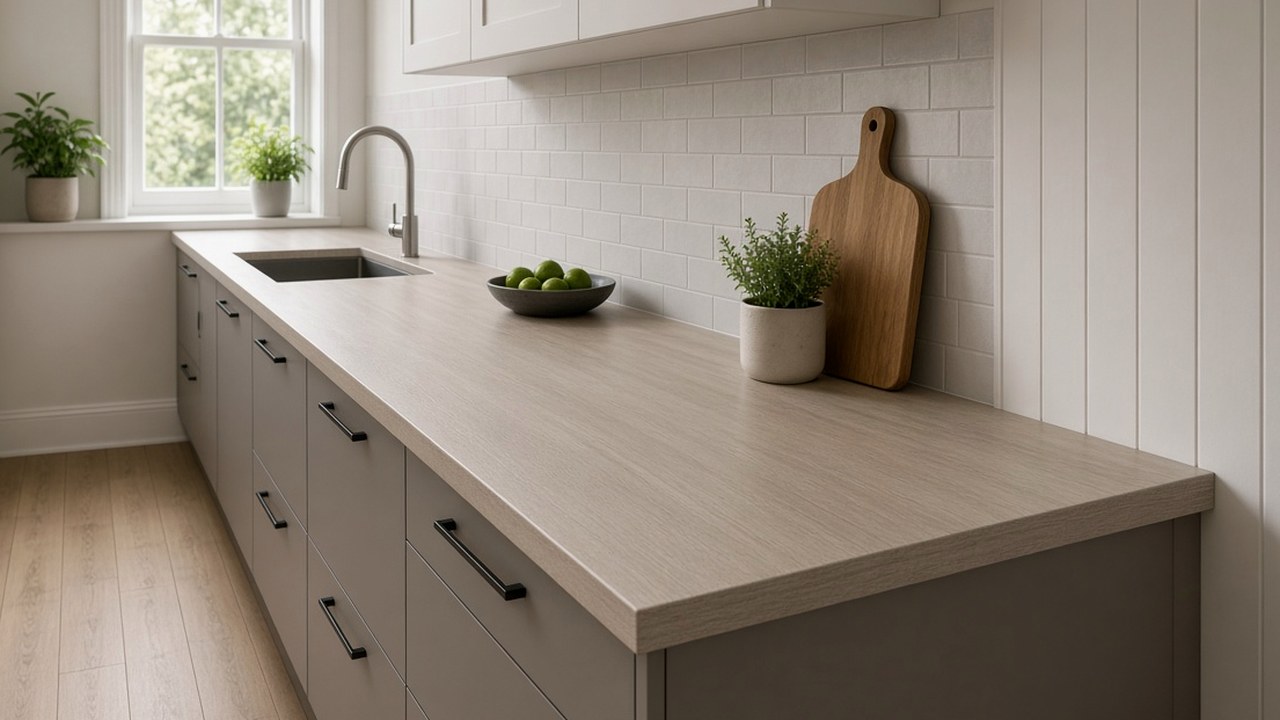
If you are choosing between a seamless run and a mitred island, the notes below are the checks we use on site. This note is written for Kitchen Worktops Direct readers who want a practical view of colour, thickness and fitting before they lock a specification.
Unless your kitchen is a single straight run shorter than one slab, your worktop will have at least one joint. Joints are normal, but their position and quality affect how the finished kitchen looks. Kitchen Worktops Direct explains the main types of worktop joint and what to expect from a well-made one.
Contents
1 Why worktops need joints
2 Butt joints
3 Mitred joints
4 Masons mitres on laminate and wood
5 Seamless solid surface joints
6 What makes a good joint
7 Where joints usually go
8 Joints and veined materials
9 Access and slab size in London homes
10 Maintaining joints over time
11 Joints around upstands and splashbacks
12 What to check on fitting day
13 Joints in laminate near the sink
14 Frequently asked questions
Why worktops need joints
Worktop materials come in sheets or slabs of limited size. L-shaped and U-shaped kitchens, long runs and large islands often need more than one piece. Joints also make installation practical, because very large pieces can be difficult to carry through homes. Our guide to kitchen worktops for flats and small kitchens covers access issues.
- Slab sizes are limited.
- Corners and long runs need joints.
- Access can limit piece size.
Butt joints
Here are the kitchen worktop ranges we currently supply:
A butt joint places the end of one worktop against the edge of another at 90 degrees. It is simple and common in quartz and granite kitchens. The joint line runs across the depth of the worktop and is filled with colour-matched adhesive.
Mitred joints
A mitred joint cuts both pieces at 45 degrees where they meet at a corner. The joint runs diagonally. Mitres can look neat on patterned materials, but with veined quartz the pattern may not align perfectly.
Masons mitres on laminate and wood
Laminate and wood worktops often use a masons mitre, where one worktop is routed to receive the other with a short mitred section at the front edge. It is strong and neat when done well. Our wooden worktops guide covers wood-specific details.
- Common on laminate and wood.
- Strong joint with a neat front edge.
- Requires accurate routing.
Seamless solid surface joints
Solid surface such as Corian is joined with colour-matched adhesive and sanded flush, producing joints that are very hard to see. This is a major advantage of solid surface. Our article on whether Corian worktops are worth it explains more.
What makes a good joint
A good joint is level, tight, colour-matched and positioned sensibly, away from sinks and hobs where possible. Ask your fabricator where joints will fall before templating. Our guide to quartz worktops explains joint planning for veined quartz.
Where joints usually go
Fabricators aim to place joints where they are least visible and least stressed. Common positions are at internal corners of L- and U-shaped kitchens, between long straight runs and occasionally across an island that is longer than a single slab. Joints are usually kept away from the edges of sink and hob cut-outs, because the narrow strips of material around cut-outs are weaker.
When you receive a layout drawing, check each joint position and ask why it has been placed there. Often there is a practical reason, such as slab size or access.
- Internal corners are common joint positions.
- Joints are kept away from cut-out edges.
- Ask about each joint on the drawing.
Joints and veined materials
Veined quartz and marble-effect materials make joints more noticeable, because the pattern may not continue perfectly across the join. Some fabricators match veins across joints where possible, a process called vein matching, which requires careful slab planning. Plain or finely speckled colours hide joints best. If an invisible joint is important to you, discuss this before choosing the colour.
Access and slab size in London homes
In many London homes, access is the reason for extra joints. Narrow staircases, tight hallways, lifts and basement kitchens can limit how large a piece fitters can carry. A long island may need a joint simply because a single piece cannot be carried in. Our guide to kitchen worktops for flats and small kitchens looks at access issues in more detail.
- Stairs and lifts limit piece size.
- Basement kitchens often need more joints.
- Discuss access at the survey.
Maintaining joints over time
A well-made joint needs little maintenance. Clean it like the rest of the worktop, avoiding harsh chemicals that could affect the adhesive. If a joint ever opens slightly, often because cabinets have moved, a fabricator can usually re-bond it. On solid surface, joints can be re-sanded and refinished with the rest of the worktop.
Joints around upstands and splashbacks
Upstands and splashbacks also have joints, usually aligned with the worktop joints for a neat look. Ask your fabricator to show upstand joints on the layout drawing too. Our guide to kitchen splashbacks and upstands explains the options.
What to check on fitting day
Before the fitters leave, run your hand across each joint. It should feel flush, with no raised lip. Look at it from a low angle under the kitchen lights to check the adhesive colour. Raise any concerns straight away, while the fitters are still on site.
- Run your hand across each joint.
- Check colour match at a low angle.
- Raise concerns before the fitters leave.
Joints in laminate near the sink
Laminate joints are the most vulnerable to water, because moisture can swell the core if it gets into the joint. Fitters usually seal laminate joints with a colour-matched jointing compound. Wipe up standing water around laminate joints promptly.
Frequently asked questions
Will I be able to see the joint in my quartz worktop?
Usually a fine line is visible close up, especially on plain or veined colours. Good fabrication keeps it tight and level.
Are solid surface joints really invisible?
They are usually very difficult to see because they are glued and sanded flush.
Can I choose where joints go?
Discuss joint positions with your fabricator before templating.
Why does my kitchen need more joints than expected?
Slab size, access through stairs or lifts, and cut-out positions can all add joints.
Can veins be matched across a joint?
Sometimes, with careful slab planning. Discuss vein matching before choosing a veined colour.
What should I do if a joint opens?
Contact the fabricator. Joints can usually be re-bonded, and solid surface joints can be refinished.
Why do laminate joints swell?
Water can enter the joint and swell the core. Proper sealing and wiping up standing water reduce the risk.
Are joints weaker than the rest of the worktop?
A properly bonded and supported joint is strong in normal use. Avoid standing or kneeling on joints and keep cabinets level beneath them.
Next step
Planning new worktops? Request a quote, order a free sample, or read the London worktops buying guide.